Tuesday, April 10, 2012

Long Overdue Pictures: Part 1

These lizards are EVERYWHERE in Uganda. This little guy made a nice home in my room. One incredible discovery: they eat cockroaches! yay!

One of the Genocide Catholic Church memorial sites in Rwanda
Having fun at home with Gloria


Notre Dame girls at the equator!

Western Uganda: simply incredible

Solar panels built in a UN Millenium Village in Western Uganda

A maternity ward in a clinic in the Development Village

Banana Plantation

Soooooo many bananas in this country!

Very hilly topography

And I'm Back!

Hey everyone!

I apologize for my long absence. It has been pretty busy around here, and with the combination of traveling and limited internet time, I regret that I have neglected my blog a bit/a lot.

The last several weeks have really been wonderful. I think it will be difficult for me to explain everything in detail, so I will start with some pictures and see how far that takes me.

First, though, I think I will try to explain how the program works. The first 8 weeks are composed of classes in Kampala supplemented by two week-long excursion. The first excursion took us to some of the western parts of Uganda and Kigali, Rwanda. We went to a refugee settlement, an UN Millenium Village, Queen Elizabeth National Park, and some genocide memorial sites in Rwanda. The second excursion allowed us to explore some of the eastern parts of Uganda. We saw the source of the Nile River and got to live in a rural village for a few days. We also got to scale mountains, venture through a couple caves, and climb to the base of a few waterfalls.

I am currently in the final stage, the "practicum period,"  or the last six weeks of the program. During this period of time, I am conducting an independent research project that I will eventually draw upon to write a research paper. For my research, I am trying to explore some of the challenges facing health care workers in a particular setting in Uganda. I will be working in a clinic outside of Kampala, and my first day of work is tomorrow!

I will post more updates soon! (promise)

til next time

Saturday, February 11, 2012

Week 2 Wrap-Up


Buganda Parliament

Thursday in the afternoon my class went out for an excursion to learn about the kingdom of Buganda in the central region of Uganda. We saw the Buganda parliament, palace, and went to the Uganda Museum. It was very interesting to know that the people who are part of the Buganda Kingdom in the central region of Uganda are ruled by both the King of Buganda and the President of Uganda. 


Buganda Palace

We were not allowed to enter the palace because we are not royalty, but we did get to see the chambers that were formerly used to torture enemies of the king. It was very scary. We saw cells that were raised about 4 feet above the ground that would apparently hold hundreds of prisoners at a time. They wouldn’t feed them, so people would die every day. To ensure that the prisoners would not escape, the ground in front of the cells would be filled with about 13 inches of water, of which an electrical current was passed through so that anyone who tried to escape would be instantly killed. When people died they would roll them out of the cell into the water to get them out of the way. When people were brought there, the intention was to kill them, and no survivors have been found. However, there is a lot of controversy with this story, and some people do not believe it to be true. One of our drivers was angry we went there and claimed it was only a tourist attraction that only aimed to make money. 


Buganda Torture Chambers

On Friday we visited one of the larges slums in Kampala. About 20,000 people live there, and the conditions are incredibly deplorable. Ditches are cut through the roads and raw sewage flows everywhere, of which children play around. “Houses” are tiny and only a few inches apart. At many moments I felt like I was looking at the pages of a TIME magazine. It’s very difficult to maneuver in the slum as the ground is very uneven, the paths are small, and there is garbage and waste everywhere. Fatal disease is rampant, including malaria, yellow fever, diarrhea, typhoid, AIDS and many others. About 1/3 of the school-age children do not go to school. Most people who are born there never leave.

From the car on the way to the slums

I saw sad children and happy children, clothed and naked. Some with shoes and some without. I saw small children holding even smaller children. When they caught a glimpse of us, they were so excited and they followed us around in bunches. Some even tried to hold my hands or just touch my white skin. I don’t know what’s going to happen to all those kids. It seems like Uganda receives so much international aid and the fruits of so very many NGOs, so why are there still so many people living like this? Where is all the money going? People are literally dying of diarrhea everyday, and yet the Ugandan government has nothing to say about it. Candidates come to this slum, campaign, tell the people their lives will be better, and then forget all their promises and never think about these poor people again. It’s truly heartbreaking. 

I’ve been in the beautiful country of Uganda for two weeks now. The things I’ve learned and observed have undoubtedly opened my eyes to some of the serious issues plaguing development. Yet, somehow I don’t think stops there.

Being in Uganda has also allowed me to understand a lot of things about my own wonderful country, the US. I think we have come a long way, but we still have a lot of work to do. Some issues are very different than the ones facing Uganda, but some, I’ve realized, are not so dissimilar.


til next time


Lists

Things I miss: 

o My family and friends

o Being able to cross the street without witnessing my life flash before my eyes

o Having a mirror

o Flush-toilets

o Driving

o Traffic laws

o Eating a well-balanced meal

o Waking up 15 minutes before class

o Walking to class

o EPA-regulated air quality

o Reliable electricity

o A sink

o Showering

o Flex Points

o Understanding the language

o Blending in

o Not being overcharged because I am a Mzungu

o Not living out of a suitcase

o Not sweating constantly


Things I’m grateful for: 

o A wonderful host family and awesome new friends

o Being independent and getting (way) out of my comfort zone

o Having no idea what I look and laughing about it later

o Learning what it’s like to live without the comforts I take for granted

o Beginning to understand the root causes of particular problems in the world, and acquiring insight from their complexities

o Learning to be more patient and understanding

o A homey SIT resource center with incredibly friendly and helpful staff

o Learning how to budget wisely

o Learning a spoken language that very few foreigners know and using it to my advantage

o Bargaining, haggling, and standing firm when arguing a price

o Hand sanitizer

o Appreciating the significance of precious water (“Water is life”)

o Having a sense of humor

o Wet wipes

o No socks

o Every day is at 75 and sunny

o Being able to (almost) fully cope with my roommates: the ants, cockroaches, and lizards

o Fresh mangoes and pineapples and bananas prepared daily

o A sweet green mosquito net


Odd things that are becoming normal: 

o Watching herds of cattle with huge horns walking down the side of the road

o 3-foot tall birds flying and walking around the city

o Daily marriage proposals (“Marry me mzungu!”)

o Little kids following me around and trying to hold my hand or touch my skin

o Dodging boda bodas while making my way on the sidewalk

o Giant open manholes in the sidewalk

o Barbed wire on the sidewalk and medium

o Car-sized crators in the middle of the road

o Driving on the wrong side of the road to “maneuver” around traffic

o Eating basically the same thing every meal

o Evangelicals yelling Bible passages in Luganda to the people of my stalled taxi

o Piles of burning trash everywhere

o Four people riding a boda boda

o Carrying my backpack on my front so nothing gets stolen

o Taking a nightly shower with a flashlight in the dark

o Never understanding what people are saying

o Having a family that speaks Luganda to one another and English to me

o Knowing that people are talking about me, but not understanding the language

o Constantly being stared at wherever I go

o Waiting 2 hours to get a meal at a restaurant after ordering

o Chickens everywhere

o Hearing people yell something like, “Hello mzungu how are you?” at least 35 times a day

o Waiting to use the bathroom until I get to school in the morning

o Brushing my teeth at school

o No trash cans

o Constant misunderstanding

o Law enforcement officials that carry AK-47s

o Thousands of people selling things EVERYWHERE

o Eating dinner at 10:00pm

o Watching Mexican soap operas dubbed dually in English and Luganda on a nightly basis

o Being called by a completely different name by my host family


til next time

Thursday, February 9, 2012

First few days of School

Monday was my first day of school! I woke up at 5:30am, got ready, ate breakfast (eggs with tomatoes and chapatti), and left the house with my host dad and little sister at 6:30 while it was still dark outside. Driving on the road by our house, my host dad saw his “sister” (not sure if biological or just Ugandan) walking on the side of the road, and we pulled over to give her a ride. We ended up dropping her off at a has station (I was very confused the whole time because they only spoke in Luganda together) then dropped off my sister at her primary school. We got to the SIT Resource Center, my school, at about 7:10 am. I was the first person to arrive, because school starts at 8:30 and most of the other students were riding in the crazy/unreliable taxis, but the program assistant got there moments later and we went in together.


Our school is very secure. We have a gate around it and a guard has to let us in. Sometimes he pats us down or checks our bags. We’re also really lucky to be in a nice part of Kampala. It’s very quiet and peaceful around there, and we like to call it our little oasis.


School was great. I have Luganda class from 8:30 to around 10:30, then break until 11, when I start another class until lunch around 12:30 or 1:00. Lunch ends at 2:00, when we have a guest speaker or site visit every day, and school will usually end somewhere between 3:30 and 5:00, depending on what is on the schedule. Yesterday after school my host family (Dad, Mom, and I think some clergy person) picked me up in our car. They arrived at about 5:30pm. We had a little bit of confusion because school got out at 4:30, and my host sister was coming to escort one of my classmates to her home on the taxis. We decided to all leave together in our car, so it was my host dad and the other guy in the front, and my host mom, me, my classmate, and my host sister crammed in the back seat of a little car. We then picked up my little sister from school, making it 5 people shoved into the sweaty back seat.


As I’ve mentioned before, traffic here is ridiculous. I’ve never ever seen anything even close to it. There aren’t any lanes, and people swerve in and out of incoming traffic on a regular basis. Cars and motorcycles even drive onto the sidewalks and honk at people to get out of the way. There are potholes/craters the size of sedans and speed bumps that hit the bottom of the car when you drive over them, regardless of speed. Traffic can stay at a stand-still for very long periods of time, and drivers just cut the engine to save fuel. We sat with the engine off for at least 11 minutes, and it took about 45 minutes to go 2 or 3 miles.


When we finally got home, I worked on my homework, ate my dinner, bathed, and went to bed. I was so exhausted by the end of everything.


Yesterday morning I woke up, ate breakfast, and drove with my host dad to drop my little sister off at school. I got to escort her to the gate this time and wished her a good day. At this point it was about 7:00, and my host dad told me he had to stop at a meeting then would drop me off at school.


It was actually a Rotary Club meeting, and he is about to be inducted I think. They introduced him to the whole room of people, then I was introduced as Shannon/Nalule from the US. We were only there for a short while, then he dropped me off at school around 7:45.


After school, my host sister came to escort a classmate and me home, and I rode the taxis home from school for the first time. I take two taxis to get home; one to the old taxi park, and one to my home. You never really know what you’re going to get on a taxi here. In my taxi, the conductor and a passenger got into a small fight, yelling at each other in Luganda and sort of swinging at each other as we were moving along. I was horrified, but everyone around me was laughing. I asked later, and apparently the passenger only spoke a certain dialect of Swahili.


At the taxi park, I found my taxi and rode home by myself. I was a bit nervous, but it was a very easy and surprisingly fast, about 30 minutes (no “jams” on my route!). The cost was about 1000 Ugandan shillings, which is less than $1. When I got home, my younger sisters were eagerly awaiting my arrival. I brought some bubbles with me to Uganda, so we decided to play with them outside. We had a lot of fun, as you can probably see from the pictures I posted! They were obsessed with my camera, and they loved taking and posing for pictures!


Later I brought out my computer and iPod touch, and everyone completely freaked out with excitement and curiosity as I showed them how each device worked. On my computer I showed them the pictures and videos we had just taken, as well as some of the other pictures and videos I had on my computer. On my iPod I showed them how to play music and play games. Two of them sat together, one headphone in each ear, and I laughed as they sang and danced along with the music.

til next time

Tuesday, February 7, 2012

Pictures!


It's really late for me and my computer is about to die, so I will save the explanations and post for tomorrow! Hope you enjoy the pictures!!

Sunday, February 5, 2012

This morning I went to my host dad’s service at the church on our compound right next to my house. I had originally planned to go to the English service at 8am, but changed my mind and went to the Luganda service with my host mom at around 10. I was really interested to see what it would be like because I have never been to an Anglican service before. It was certainly very different than Catholic mass in America. First of all, it was three hours long. It was all in Luganda, so my host mom whispered to me what was going on at various points and told me when to stand, sit, and kneel. Since we are the Reverend’s family, we sit in a special place in the front in a pew sort of perpendicular to the altar. The reverend introduced me to everyone during the service, calling me his daughter. The service was composed of various energetic hymns, bible readings, sermons, recognition ceremonies, a sort of fundraiser, and other things. It was very hot in the church, and my host mother continuously told me that I could leave at any point if I was bored/tired/hot, but I decided to stay for the whole service. When I got back, I ate a delicious lunch and played with my sisters. It’s quite funny because whenever I sit on our back porch, all of the people in the other houses around the compound just stand and stare at me. It’s quite a common occurrence wherever I go, so I’m quite used to it by now.


Later on, I took a taxi with one of my older sisters to another relative’s house down the road that is hosting one of my classmates. We hung out for a little while (and I stealthily used the flushing toilet in their house), then drove to the SIT classroom building so we could time how long it would take to drive there tomorrow morning. After this, we went to the mall in Kampala. It was very nice, and at this place I saw more white people (mzungus) than I have ever seen in Uganda.


I’m about to go to sleep right now, and in the morning my host dad will drive me to the SIT building for my first day of school. Nervous, but can’t wait!


til next time

I live on a Compound!

Yesterday morning I moved out of Jeliza hotel and prepared to meet my host family. Our group piled into a couple of vans (with one extra van for all of our luggage) and first went to Makerere University to take a driving tour of campus. When we were finished with this, we drove over to the largest public hospital in Uganda. Our program staff have been warning us all week to never ride a boda boda motorcycle in Kampala, so today they took us to one of the wards at the hospital to see some of the people who have been injured in boda accidents. Going to the hospital was a very interesting experience. In the ward, I was immediately struck with sadness as I saw such incredible overcrowding, poor sanitation, and crumbling facilities. There is nowhere for families to stay, so they literally bring mats and towels and sit around the beds. They have to bring their own food and water, so there is junk scattered everywhere. The whole scene was incredibly heartbreaking, and it really made me want to think about issues of public health more seriously.


After this site visit, it was time to meet our host families. We drove to a very nice hotel in Kampala and met them in an outside area with tents set up and food laid out. The whole experience was kind of hilarious. As we (the students) entered the grassy area of our meeting place, we stood in a straight line, shoulder to shoulder. Our host families fashioned themselves the same way facing us. One by one, each student’s name was read aloud into a microphone along with the host family’s. The student and family would meet in the middle, embrace (with pictures being snapped by an program assistant), and then walk over to the tent area for a snack and something to drink. My name was one of the last ones called, but eventually I met my family in excitement and anticipation.


After a little while we left to return home. My host mother briefly mentioned “the compound” a few times, and I finally found out what that meant. My host father is a Protestant Reverend and he has a good deal of power and responsibility in the community. We live in a humble home, but on the land composing our compound is his church, a clinic, a school, a dormitory for girls, a small plantation, and a bunch of houses for a lot of other people.


The day was incredibly exhausting, yet unbelievably amazing. If you were to ask a Ugandan woman how many children she has, she might reply, “We don’t count our children here.” Ugandan families include both biological and ‘adopted’ children. Adopted children to us might be cousins or nieces or nephews, but to the Ugandan people, they are all their children, brothers, or sisters. In my new family I have five other sisters, ages 26, 21, 7, 4, and 8 months. My “mommy” is 30, and my dad is 35. Since I am now part of the family, they gave me a name that signifies I am now part of their tribe: “Nalule” (pronounced nah-lue-lay). When I first heard it, I could never remember it, but I am often called by my new name that I actually remember to respond to it now.


In our house we have electricity, but no running water and no toilet. We use a pit latrine, and I use about a gallon or two of water to shower with. I scoop a bucket onto a cup to pour it on myself. Ugandans are very clean people. My host family requests that I shower at least every night before I go to bed, and I am invited to take another shower in the morning or earlier in the afternoon if I wish. Last night was my first shower, and I misjudged the amount of water. Today was much more successful. I have a room in the house that is used for my “shower”, but it doesn’t have a light in it, so I place my headlamp on a bench to light it up. The rest of my sisters bathe in an outdoor shower in a room next to the latrine.


The kitchen is located outdoors in a small building of sorts next to the house. We cook using a small charcoal stove, and some things are heated up with a gas stove inside the house. There are ants (of various sizes), cockroaches, and lizards inside the house and all over. These huge ants climb on the table in in the sugar, and there are at least two spots on my wall where hundreds of small ants are climbing in a straight line to some undetermined location. The first time I used the pit latrine was last night, and when I shined my headlamp inside, a cockroach came running out at me. This afternoon my host mom was sitting in a chair next to the wall and a small lizard appeared right next to her head. I actually squealed with delight and everyone thought it was very funny that I had never seen a lizard quite like that before. My older host sisters and mom label all these things as “harmless,” but I think it might take me a while to get used to some of them, namely, the cockroaches.


Our compound is really cool, and you can see Lake Victoria when you stand in the plantation. I asked my host mom if I could see inside the school sometime, and she asked me if I wanted to teach! Maybe I’ll be doing that in the future? We shall see. I’m also really interested in learning about the clinic. After going to see the hospital yesterday, I’m curious to know what it’s like. Also, we apparently live down the road from the president’s daughters, so I’m keeping an eye out. Even though I have absolutely no idea what they look like.


At several times during the past two days, I just smile with disbelief. I’m living in Uganda in a house with a family that is so very different than anything I have ever known. I carry around an adorable African baby, eat fresh pineapple with my fingers, and watch Mexican soap operas dubbed simultaneously in English and Luganda (like, one character speaks English, the other Luganda; I only understand half of what is going on at any given moment and my host mom whispers to me the plotline and what the characters are saying, thinking, and feeling). I’m currently sitting in my bed under a mosquito net listening to the crickets and the sound of the TV in the living room (that thing is on all day long). Driving through town, I see chickens walking on the side of the road and skinny cows with HUGE horns being herded around by an even skinnier man. I relieve myself in a hole in the ground.


I arrived here a week ago today, and sometimes it seems like I’ve been here for much longer. I’ve already learned so much, but the more I learn the more I realize I don’t know.


til next time

Friday, February 3, 2012

This morning was our final day of official orientation activities, and we held our meetings outside on the campus of Makerere University. We were so very distracted by the giant storks walking around that it was at times a bit difficult to focus! We went over some of the rules and policies of the program and wrote a constitution for all of us to abide by. We got lunch on our own in groups, and it took about an hour and fifteen minutes to finally receive the food we ordered. As I’ve said before, time is just different here in Uganda.


We also received some of the information concerning the host familes we will be moving in with tomorrow. Each student has their own family, and we will be staying with them for about four weeks. We’re moving out of the hotel tomorrow morning, and I’ve got to say, I’m going to miss Jeliza Hotel! However, I’m really excited to meet my host family tomorrow.


After all of our activities this afternoon, we had our own free time. I needed to purchase a cell phone and a new power converter. I ended up buying a phone for less than $30, and haggled the “non-negotiable” price of the power converter down to about $1.75. Not bad!


I ate dinner outside in the garden of Jeliza, and got to spend some time with my classmates for a little while. I’ve just basically finished packing and I’m ready to move out tomorrow morning!

til next time

Drop Off

Yesterday was a really big day for me. My classmates and I experienced our first “drop-off” exercise, in which we were paired and sent off on our own to learn about some topic in the city of Kampala. My partner and I were given the topic of transportation. Others had things like health, education, food, and entertainment. For our topic, we planned to visit the Old Taxi Park, the New Taxi Park, and ride in a taxi for the first time. All of the groups were also instructed to buy mosquito nets, which we will use when we move in with our host families tomorrow.


To learn about transportation, we first tried to look at a map to figure out where the taxi parks were. Maps aren’t very widely used in Kampala, and the one we had was not very helpful. So we decided to start walking in the direction we thought the parks might be in, and ask someone along the way. Our program staff had been telling us that Ugandans are very friendly and helpful people, and this was certainly confirmed. Using some of the Luganda language skills we learned the day before, we approached a man and asked him where the Old Taxi Park was. Ugandans absolutely love when Mzungus (white people) speak the local language because it seems to show that we’re really trying to be more than just tourists; we’re interested in the people and we want to learn their language to be able to communicate with them. We tried to greet each person we met with Luganda and also thanked them when we were finished. It truly felt incredible!


Using the directions offered by a few different people (directions here are funny: “you know the petrol station next to the pharmacy? Go down down down and turn right, then left, then slope down and turn right. It’s very easy and very close.”), we finally made it to our destination: the Old Taxi Park. The two taxi parks in Kampala are incredibly overwhelming to say the least. The only way I can attempt to describe it is to picture a huge dust-covered parking lot with vans crammed together in every which way as far at the eye can see. Different stations mark the departure routes for the taxis. Taxis in Uganda are kind of like buses in the US. They have a certain route that they take with a few stops, but basically you just need to yell something to the driver when you are nearing your stop. The taxi will pull over, and you will pay your fare. Taxis have 12 or 16 seats for passengers and a driver. The taxis cannot leave the park until they are full, so some people will have to wait a considerable amount of time just to begin to leave, not to mention the amount of time it takes to find a way out to get back to the road.


If this were not overwhelming enough, the area directly surrounding the taxi park is composed of a large marked filled with everything and anything. I saw clothing, shoes, sim cards, fabric, mangoes, small electronics, and so many other things, including mosquito nets, which we dutifully purchased (I got to haggle for the first time!). The area is so congested, and it is a place that requires special vigilance in all the shuffle, or you are almost sure to have something unknowingly snatched away from you if it is not secured.


Not only are there vendors with small makeshift shops set up around the park, but there are people walking between all the squeezed-in taxis peddling a variety of things like wallets and passion fruits to the people walking around and sitting in the waiting taxis. After taking all of this in, my classmate and I decided to head over to the New Taxi Park to see if it was similar. On our way through the markets on our way out, we began talking to a vendor named Muhammad that was selling shoes in his shop. He asked about America, and me that I should consider moving to California because he really likes Schwarzenegger (who we begrudgingly informed him was no longer in office). We asked him about life in Uganda, and told him we were students studying in Uganda for the next three months. He was really surprised we were here to study because, he said, most students in Uganda would give anything to be able to study in America. It reminded me how lucky I am. Altogether, the conversation was about 15 or 20 minutes. In the end, we asked him if he could point us in the direction to the New Taxi Park, and he actually left his shop to walk us there himself.


After observing the area for a bit, he asked us where we wanted to go in the taxi and I showed him the address of our hotel that I had written down in my notebook. He took us to the right taxi, confirmed with the driver, and was ready to send us on our way. He even wrote down his two cell phone numbers for us to call if we got lost or needed any help with anything. It was a very different experience than anything I’ve had before, and his kindness really made me smile.


We were some of the last passengers to board the taxi, and when it was finally full, we still could not move for another 20 minutes. For us to move, several other vehicles in front of and around us had to move out of the way. There was a lot of honking, yelling from driver to driver, and even a couple of people started whacking the back of the taxi with their hands. As I looked around at all of the other passengers in our taxi, I couldn’t help but laugh when I realized this was simply commonplace; no one even batted an eyelash.


The taxi driver would turn the engine on, and we would move a couple of feet, then he would turn it off, and we would wait for a couple of minutes for the taxis in front of us to move again. More yelling. Meanwhile, vendors everywhere poked their heads through the windows trying to sell us leather wallets and yards of fabric. Finally as we began creeping forward at a slow, yet consistent rate, we entered the street of the market surrounding the taxi park. The taxi was only feet away from vendors on either side of the “road” with people walking everywhere. Once again, I don’t even know how to begin to describe such a spectacle. It was insane.


When we finally got out onto the real roads, I realized I didn’t even know when or where the taxi was supposed to stop in relation to our hotel. Like I said, taxis don’t take you to a specific place like a cab in the US, they each follow a particular route, and people yell to the driver when they want to get off.


Needless to say, we missed our stop. We eventually got off, paid the driver, and ended up walking for a very long time back the direction we had just come. Another “assignment” was to get lunch on our own, something that we would be doing for the first time. We saw a sign for a restaurant, crossed the road, and entered a compound-like area that housed the restaurant and a couple of other buildings. We looked for the “restaurant”, but found only an empty restaurant-looking building with no patrons and no food. We left and continued onward.


After consulting the map, we realized that we had a long way to go, so we began looking for a taxi to take us back to the hotel. Every taxi that passed us by was jam-packed. We continued walking of the dusty “path” next to the road. Once again, I couldn’t help but laugh: this “path” had bodas whizzing by, giant tree roots protruding, rocks, open man holes, and a plethora of other things to keep us on our toes (literally). However, this is how most of the “sidewalks” are in Kampala, so I’m learning to get used to all the new obstacles (though still tripping and falling on a couple of occasions).


We finally found a large taxi stop, hopped on a taxi, and rode right back to the hotel. We paid our fare, but were not given any change. We insisted several times for the “Balance” (using some of our Luganda) and were finally given our due change. As I’m quickly learning here, you have to be pretty firm if you don’t want to be taken advantage of.


We got lunch at a place close to our hotel (after walking up to another deserted restaurant in a weird alley), ate an carb-intensive meal, and headed back to our meeting spot in the hotel garden with about fifteen minutes before we were due back. Overall the experience was so much fun! It took a lot of patience, confidence, and a sense of humor, and overall I thought we did quite well!


Later that night, a group of about 10 of us decided to go to dinner at a restaurant called “Boston View.” We were seated at three different tables, and given one menu for each table. After about 15 minutes the waitress took our drink orders and brought out our drinks several minutes later (you have to say “waTer”, not “wa(d)er” or they have no idea what you mean). Before we could order our food, we had to pay for our drinks. Kind of strange, but we went with it. Several minutes later, the waitress took the orders of one of the other tables. About 20 minutes after that, she took the orders of the other table. About 25 minutes later she began to take the orders of our table. Whenever someone tried to order something, she said that they had none left. I eventually just asked her what food they did have left, and she informed me that had chips (French fries), sausage, and Chap (which has something to do with eggs apparently). That was all. We decided to leave and go to another restaurant.


We ended up at another restaurant that was incredibly delicious, had excellent service, and was quite charming to look at. The prices were much higher, but we were very grateful to be eating such wonderful food.


By the end of the day I was covered in dust, but still no sunburn or mosquito bites! I'm pretty sure I fell asleep before I hit the pillow last night. 

til next time

Wednesday, February 1, 2012

My first couple of days in Kampala

I arrived in Kampala two nights ago, and what a trip it was! Getting off the plane, I was immediately hit with the balmy, stagnant equatorial heat that enveloped me like a wet blanket (my favorite-no lie!). The first thing I noticed about the airport was its simplicity and overall lack of clear structured organization. On my way to the immigration desks, I literally walked past a pair of doors that opened wide to the runway. Making my way to passport control, my group of fellow SIT students and I had a decision to make. Since we had all already applied for and received our visas, we did not need to enter the long line to get them. We asked an airport security guard who directed us to the line for U.N. officials and other important people. Sweet! After this, a couple others directed us to the front of the line where we essentially cut in front of everyone else who had been waiting. None of us really knew why, but we just went with it, which I’m finding is a common theme in general here.


Eventually we made it through and picked up our luggage. I was so astonished that my two bags had actually arrived at Entebbe airport after all the trouble I had in Chicago that I didn’t complain about the newly broken handle on my suitcase (unfortunately it didn’t end there). We made our way out and were greeted by our SIT representatives, who ushered us to the parking lot. The first thing I noticed was the smell of the air. It smelled like a distant campfire, something that was both comforting and familiar in this strange place. Making our way to the van was an interesting experience. It was about 11:30PM, and the parking lot had very few lights. We began to pack the back of the van, and I couldn’t stop laughing because we were literally bumbling around in the dark trying to pack it up. When the back was filled, our driver climbed on top to place extra baggage up there. The sight of three or four girls struggling to lift up several over-stuffed and over-sized pieces of luggage into the hands of a man standing on top of a van in the extremely lit parking lot must have been an entertaining one. When we all piled in and drove away, I realized that the entire airport parking lot was probably smaller than the one at my 400-student high school.


The drive from Entebbe to Kampala was probably about 30 minutes, 29 of which found me clenching my seat or squeezing my muscles like a nervous wreck. Driving in Uganda is very different than the US. Not only is it on the left side of the road, but it’s completely insane. Cars pass each other right in front of incoming traffic. There aren’t sidewalks in many areas, so people (including children) are walking on the side of the street merely inches away from speeding vehicles. Boda Bodas, which are crazy dangerous motorcycles, zoom in and out of traffic, almost grazing other vehicles and driving so close they make my stomach hurt.


Even though it was late at night, people were still out and about. Unfortunately, in the dark we could not see very much, but the feelings and thoughts pulsing through me were quite vivid nonetheless. Entebbe airport is right on Lake Victoria, so I was able to catch a glimpse of it, which really made me smile.


As our van got closer and closer to the city center, I began to notice increasing levels of smog. I could see it in the soft glow of the lamps, and could feel it in the back of my throat. Ugandans burn much of their garbage. They also burn coal and wood for fire, which release increased levels of carbon dioxide into the air. In the capital city of Kampala, they have in incredible of cars, vans, and boda bodas on the roads, which I noticed emit black fumes. All of these things combined create smog, with the humidity and CO2 trapping it quite efficiently.


The rules of the road in Uganda are very interesting, or perhaps rather the lack thereof. The only stop sign I have seen so far was the one at the exit of the airport. I don’t think I’ve seen a speed limit sign, and most of the roads are not marked, even in the capital city. People just pull right in front of one another as bodas zoom around every corner of every vehicle. Taxi vans crammed with people are the norm in local public transportation. The city only has a handful of stoplights, which are even more inefficient than the madness that goes on without them. The streets are paved, but littered with potholes, craters, and horrific speed bumps. I don’t think I could ever drive in Kampala, but I certainly have a huge amount of respect for the people that do.


When we finally arrived at our hotel, I couldn’t wait to get right into bed. My room is on the second floor (called the first floor here). It’s simple, yet comfortable. It is actually much more spacious than I thought it would be. A big wooden door opens up to a small hallway that leads to the sleeping area. There are two beds, one for me and one for my roommate, with mosquito nets hanging above them. On the right is a door to the bathroom. Our room even has a TV and mini fridge.


When I set down my things and began to open my bags and get organized, I realized it must have been an incredibly traumatic journey for them. My shampoo, conditioner, and toothpaste had all exploded on my things! I really couldn’t be angry; all I could do was laugh. After all, it was kind of funny and I was kind of delirious from the long hours of traveling. In one of my suitcases I also had a bottle of permethrin spray. Permethrin is an insect repellent that is sprayed on clothing and other gear it is especially useful because it lasts up to 6 washes and it repels different kinds of insects rather effectively. I used some of this stuff to spray my clothes, and I brought the rest to re-spray after a few weeks. Unfortunately, this too exploded and soaked through a few items of clothing. Well, at least I’ll be super-protected with those.


We started bright and early the next morning (yesterday) and will be going through a sort of orientation until Saturday, when I will move out of the hotel and move in with my host family. We’ve been so busy for the past couple of days that I cherish any bit of time I get to myself. I got to exchange some of my US dollars to Ugandan shillings yesterday. The exchange rate is so ridiculous; it’s around 2300 shillings to the dollar, which will take me a little while to get used to. We went on a driving tour of Kampala yesterday, and got to drive up a huge hill where we stood before gorgeous panoramic views of the city.


We went to a restaurant for lunch that is right next to Presient Museveni’s Kampala residence. Unfortunately, I have no sightings to report. The food was delicious, but I’m beginning to see some interesting patterns in meal composition. Ugandans don’t seem to measure their meals and diets by the sorts of nutritional guidelines Americans use. They eat SO many carbs, and much fewer amounts of proteins, fruits and vegetables. Although these things are usually present, one meal could easily contain three or four types of carbs with one type of protein, vegetable, and fruit. I can already see this as being an interesting indication of health and nutritional knowledge in Uganda and other countries of Eastern Africa. Perhaps so many children are malnourished because they eat these filling carbs, but receive inadequate amounts of other important vitamins and nutrients? This is something I know will be explored further later.


We went to the SIT resource center, where we will be taking our classes, took a tour, and met some of the staff that will be helping us during the next 3 and ½ months. Toward the center of the city, there is some sort of problem with the water pressure. I haven’t heard many of the details, but what it means at this building is that if we use the toilet, we need to fill a bucket of water and pour it in the toilet to “flush” it. I’m going to try to avoid this as much as possible. I hope the problem is fixed soon. I’ve noticed it at our hotel, too. Fortunately, the toilet flushes, but only a small stream of water comes out of the sink and shower. I don’t know if this is just the norm or part of the same problem, but it definitely saves a lot of water.


The shower in our hotel room is the type that you hold and spray on yourself. The water doesn’t warm up, but I’ve found that it really isn’t that bad, and it ensures that I use much less! I asked our academic director where the water at our hotel comes from, and she told me they get it from Lake Victoria. This water is safe for bathing, washing hands, and brushing teeth, but we can’t drink it. We can’t drink any tap water, so for the moment, we only drink bottled water. This leads to many used plastic bottles, and I still haven’t found out whether or not they recycle plastic. I hope they do, but I’m worried they probably don’t.


The Uganda sense of time is very different here. No one is in a hurry. Any person on the street is willing to stop what they are doing and talk to you or help you find where you need to go. Making an appointment or reservation at 7:00 means it could basically start any time from one minute after 7 to one minute before 8, and still be on time. The traffic is so congested, that it usually takes a very long time to drive only a short distance.


Today we spent the whole day in the garden at our hotel under a shady tree continuing our orientation activities. We had two different doctors come to talk to us about caring for our own health and safety in Uganda. We then had one of the chiefs of police talk to us more about safety and the role of the police in the city of Kampala. We then had a course on social etiquette in Uganda, and followed with a yummy lunch outside. After this, we had “Survival Luganda” lessons for a couple of hours. I was so exhausted, but was relieved when we were granted two hours of free time before dinner at the hotel. Some of the others went out and explored the area around our hotel a bit, but I just had to rest a bit and felt much more refreshed afterward. After our 7:00 dinner (which began at 7:35), we stayed outside and chatted for a little while.


Right now I’m sitting in bed with my mosquito net around me. It’s 12:23AM and I’m listening to my iPod. The walls are paper-thin here, and just a little while ago I was inundated with the loud laughter of people in the courtyard and garden, speedy traffic outside, and blaring TV next door. It really doesn’t bother me, though. I’m just happy to be here. Remarkably, it’s pretty quite now!


Tomorrow is a big day. Thus far, we’ve been closely guided by our SIT staff, but in the morning we will be put in pairs to take on some sort of task in a “drop off” activity. I’m a bit nervous, but I’m ready for the challenge!


I’m starting to learn the importance of patience here. Things are just a little bit different. I received a wireless modem at the SIT center, which didn’t work. I finally got it up and running this afternoon. Cereal is served with warm milk. I patched a couple of holes in my hotel-issued mosquito net last night. I cut my finger trying to open a bottle with a fork. There’s reddish-brown dust all over me by the end of the day, especially in my hair (as I found out when I washed it an hour ago). I have to take my malaria prophylaxis every day with half a bottle of water or I will feel sick. These things might have troubled me before, but the general mellow attitude and happiness around here keeps me at ease.


This post is very voluminous and disorganized (sort of like traffic in Kampala!), but I hope it fills you in a little bit about what I’ve been up to for the past couple of days!


I’m so tired, and I know I’ll have even more to share after tomorrow. Nighty night!


til next time

Saturday, January 28, 2012

Wednesday, January 11, 2012

Word

I don't think I've said "malaria prophylaxis" so much in my life.
Actually, I know I haven't.

til next time

Tuesday, December 27, 2011

Official Countdown Starting NOW!

I just inserted a countdown to my Ugandan departure!!
Just over one month to go!

til next time

Sunday, December 25, 2011

Little Surprises


Merry Christmas!!

It's been a bit of a whirlwind since the semester ended, but I'm finally back home typing away in the peace that can only be found under the warm covers blanketing my top bunk.

It's really quite strange to finally be packing and preparing for Uganda. Talking to extended family members about my upcoming semester for the past several days has certainly brought a more startling sense of reality. I'm leaving, really leaving, in just over a month.

I haven't even left yet, but I've found myself constantly surprised by things I wasn't quite expecting. Planning for a semester in any foreign country is much more than just leaving and returning a few months later. There's so much that no one ever tells you, and I think that's one of the reasons I decided to start my blog so early. It's been an exciting process, but at times a very challenging and confusing one.

Here are some of the things I know now that I wasn't expecting:

  • Costs. Going to Uganda for three and a half months requires a lot of preparation. My health insurance covers the cost of some things, but not all. Shots, prescription medicines, visa fees, shipping and mailing fees, and transportation fees may not seem substantial individually, but when compounded can become quite expensive. I've had to purchase new clothes and shoes that are appropriate for the culture and weather, the right kind of sunscreen and insect repellant, and even a headlamp for when the power goes out! 
  • Shots really aren't that scary. 
  • Moving out of the dorm mid-year is really weird, yet oddly fulfilling. I'll miss my friends and roommate dearly, but I know that I have some exciting adventures ahead.
  • People don't know very much about Africa. (Including me!) For a lot of people I think it is easy to lose sight of the fact that Africa is a continent, not a country. Over the past few months I started realizing that we learn hardly anything about the history of the countries of Africa in school, and I think it's a shame. There is a lot of misconception and a general sense of homogeneity when thinking about African countries, including Uganda.
  • Saying you're going to Uganda for a semester is kind of unusual to most people. With just about every person I have told about my upcoming semester in Uganda, I've received three main responses: 
    1. WHAT?! [I'm shocked that you, Shannon of such fair complexion and generally predictable behavior, would ever choose something like that, but good for you!]
    2. AWESOME! WHEN DO YOU LEAVE [and when can I visit]?! *high five*  
    3. WHY [would you ever choose to go there]?!
  • All of these responses are totally warranted. It's really difficult to slide under the radar when something like this comes up. Sometimes I wish people would just say "ok, cool" and move on, but reveling in the predictability of their response, or trying to guess which one will be elicited, is kind of enjoyable and funny at the same time. When this comes up, I usually have a lot of explaining to do, and even though I'm really used to the idea of going to an African country for a few months, most people are not. There's certainly a lot of answering the same questions over and over, and in the end, people usually think I'm crazy/weird/fascinating or some sort of martyr. It's really hard to convince people that I'm just a student studying abroad, taking on a new challenge. But somehow, it's ok. In fact, it's actually made me feel more at ease just rolling with the punches in general.
  • People are extremely curious. People I haven't talked to in months or have little contact with are suddenly interested in what I've been up to; journeying to Uganda certainly brings about some funny things that don't happen during or before a regular semester at school.
  • Predicting how I will feel this summer after the program is really hard. As I attempt to plan for what I will be doing this summer, I'm having a bit of trouble even knowing what state of mind I will be in. Perhaps I will want to take on another challenge and intern abroad for another 6 or 8 weeks; but maybe I'll just want to be home doing something locally. My family is moving this summer, so it adds a bit more to the decision. I'll need to pack everything for Uganda and for the big move a few months down the road. It's not a complaint, but it's a lot to think about even before the semester begins.
  • Context is important. It is important to keep context in mind when considering in the things people say, how they act, the decisions they make, and the beliefs they have. There is a reason (or reasons) we do the things we do, and there is a certain motivation behind each action, as subconscious as it may sometimes be. 
In reading what I have written in this post and throughout my blog, I don't mean to seem pretentious, assuming, annoying, or anything else negative in origin; but I realize this is how my writing comes off sometimes, even to me. I'm merely trying to express my thoughts, concerns, worries, joys, and experiences as I perceive them. Writing a blog for me is a challenge because I've grown so accustomed to the dry, cold scientific writing required for my studies that it can be difficult for me to expand my horizons and write more candidly. However, it's a challenge I'm looking forward to and am excited to work with.

My initial intention of creating this blog was to provide a window for my family and friends back home to keep up with me in Uganda, but I can now see that it is just as much for me as it is for them.

til next time.

Thursday, November 17, 2011

Betwixt and Between


So much has happened since my last post. For one thing, I have a plane ticket. Last Thursday was my last of three pre-departure meetings with the Notre Dame Office of International Studies.  I've had a couple more medical clearances, and I'm turning in my last (hopefully) piece of paperwork tomorrow. I'm in the process of applying for a visa. Heck, I've even started to think about how I will be packing up my dorm room.

It's been a very interesting semester. I like the word "interesting." In itself it is certainly "interesting" indeed because upon initial inspection, it seems to hold neither positive nor negative connotation and leaves much to the imagination. It's a frequented filler word that I tend to use when I honestly just don't really know what else to say. Interesting...

I had a couple of interviews for international summer service programs last Sunday. It's so strange to think that by the time summer rolls around, my Ugandan adventure will already be over. It's even stranger to think about how truly important it is to still be to be fully engaged with everything going on here and now without fumbling obligations to prepare for next semester, next summer, and next year. Thinking about jobs, internships, service, research projects, applications, exams, the beast that is senior year, living arrangements, money, endless papers, while still getting enough sleep every night is a tricky balance, but I guess that's part of what college is all about; a clever discernment to discover the balance of learning inside and outside the classroom. Yet, I don't mean this to sound like a complaint. I don't feel stressed, just rushed and a bit melancholy. I feel like time is slipping away from me sometimes.

Thoughts about college experiences are on a rather confusing polar spectrum. It's really easy to dramatize daily stresses. Yet, it is also very common to trivialize the emotions and experiences of college.  I've certainly been gulilty of both. It's an odd thing. We want to learn, but with so many classes and responsibilities, we usually cannot give each class the attention we would like to. We're here to "work" but we or (for many of us) our parents are paying an incredible amount of money to be here, so there's a certain pressure get good grades. We have dreams, but for many of us, we know that we can never have our true "dream jobs." We're at a strange liminal period betwixt and between childhood and adulthood; we're treated like adults by the law and certain authorities, but yet we still depend on our parents financially and for countless other things.

 It seems like so much of college is spent preparing, looking to the future. I wish it weren't so difficult to appreciate the present. I think this is one of the things I'm most looking forward to in Uganda: achieving a simple appreciation for the present. So simple, yet so powerful.

til next time.

Monday, August 29, 2011

Like Tears in the Rain


"All these moments will be lost in time, like tears in the rain."

There are almost 7 billion other people in the world, and every single one of them is doing something right now. Sleeping, eating, running. Crying, dying, waiting. Discovering, inventing, destroying. Something. All these people have their own complexities, secrets, emotions, stories, problems, dreams. Every single one.

Each of us does things every day that few will ever know. After each of us is gone, these things will be lost, swept away like particles of dust, never to be known or thought of at night while drifting off to sleep.

Isn’t that amazing? Gone. Like that. Without any notice.

I’m beginning to realize that this is exactly why I want to get out into the world and see things for myself. It’s a matter of somehow understanding (or beginning to understand) the human experience. Right now people are doing things that I will never see in ways that I don’t understand for reasons I cannot comprehend. I won’t begin to know anything about other people if I do not meet them, live with them, and learn from them. It’s actually really similar to the idea of being in college and living with peers, just in a different setting surrounded by different people. (Okay, maybe a little different)

Today in my Archaeology class my professor showed us the scene from Blade Runner featuring the quote from above.

"All these moments will be lost in time, like tears in the rain."

I found it to be quite profound, yet melancholy. Melancholy because I realize that we’re all more than tears in the rain and our experiences and feelings are incredibly significant to each of us, regardless of how they may appear to others when inspected with a critical and comparing eye.

Does any of this have value? I guess it depends upon what ‘value’ means. When reduced to economic terms, it probably has very little, if any at all. Does it matter to our society? On the surface, it seems not, but I think there is much more to be understood. It matters to me. It offers a sense of social memory, perspective, and worth, and that’s what’s important, right?

til next time.

Simplicity


Today in an anthropology class I was asked to write about my personal educational philosophy. On the surface, this doesn't seem too tricky. I've gone to school for fifteen years; I should have a pretty good idea of what education is and how I view it.

Wrong.

I felt incredibly challenged, and I asked more questions than I answered. Luckily, my professor has a very interesting educational philosophy herself that allows me to explore and question in such a way.

The next day another professor paid homage to The Silence of the Lambs proclaiming, "Simplicity. Of each particular thing ask: what is it in itself? What is its nature?"  

Simplicity. Stripping away the incidentals to discover the principal.

In a way, as I wrote my essay, I was subconsciously trying to get there, to the simplicity of my personal philosophy. I certainly wish these wise words were in the back of my mind to remind me, though.

Sometimes people ask me, "Why Uganda?" 
Why? 
Because I want to go. 
Yet, that doesn't really get to the principal, or does it? 
Because I'm curious. 
But why?
Because I'm feeling lost here in the Midwest part of the United States and feel like I don't have any perspective of the rest of the world and the people in it.

That sounds selfish. Shouldn't I want to heal the world or save the planet? 
I do. But I'm not sure a semester of study in Uganda will achieve these things. Actually, I know it won't. I'm going to Uganda to get educated, in a different way. If I can come home changed, with a wider, more informed perspective, then I have the potential to do a lot more. 

People don't need to go to Africa to change the world, but if going to Africa can open one's eyes to the incredible variety of the human experience, I say go. Just don't expect to change the world (right away at least). 

Maybe my time in Uganda will help me to understand my own community in a new way so that I may better understand and aid the people I share a zip code with. Maybe I'll start to formulate what I'm going to do with my life. Maybe I'll simply grow a substantial appreciation for indoor plumbing.

I don't really know what's going to happen to me. The important thing is to embrace the experience for what it is. Expectations are deceptive, so I'm trying to keep an open and unformulated mind. Simplicity. It's new to me, but I know it's important.

In the end, my reflection essay was basically a mess, but that's ok. I'm learning, in my own way.

---------------
It is difficult for me to begin to pinpoint my own educational philosophy, but even more difficult is that after fifteen years of formal education, I cannot specifically say that I have one. Professor Oka told my International Development studies class, “Education matters if you can use it as capital.” I believe this is a very valid statement when concerning the merits of formal education and its goals: to give knowledge and perspective so that its beneficiary can have the tools to make a living and hopefully contribute positively to the world. However, I do not believe formal education is the only type of education, and I think it encompasses much more than a job or career path.

Education comes in many forms and from many places. Teachers are not alone. Parents, family members, peers, friends, elders, and even small children can often be the most formative instructors of ‘education.’ This leads me to the question, what is education, and what does it mean to be ‘educated?’ There are many things to be educated about, and for many reasons are people educated.

Notre Dame’s mission statement has a particularly interesting take on education:
“The University seeks to cultivate in its students not only an appreciation for the great achievements of human beings, but also a disciplined sensibility to the poverty, injustice, and oppression that burden the lives of so many. The aim is to create a sense of human solidarity and concern for the common good that will bear fruit as learning becomes service to justice."

I have to admit, in some ways this confuses me. What does it actually, concretely mean, and what are its practical implications? Theoretically, it sounds very noble, but is it feasible? At this point I am still trying to figure that out.

In essence, I am still floundering about. I don’t quite know my educational philosophy because at times I feel the things I learn outside the formal classroom setting are far more valuable and worthwhile than those picked up between the hollow cinderblock walls of a school building. In a way, it leads me back to a very substantial question: why are we here in the first place? Are we formally educated to find work? Are we supposed to work to live, or vice versa? And, how do all of these things relate to the emotions, feelings, and power of the overall human experience? What does “human experience” even mean?

I truly think that education is supposed to enhance the experience of being human, but sometimes it seems more prohibitive than anything else. It feels like a battle between the formal and informal aspects of education, and it consequently forms a bit of a contradiction. Formal education isn’t very forgiving and it provides nothing unconditionally. Informal education can be incredibly personally rewarding, but it is generally not appreciated on its own in terms of capital and economic value.

So, what is my educational philosophy? I’m not quite sure, but this question certainly gives me a great deal to think about so that I may begin to form a more structured opinion.
----------------

til next time.

Tuesday, July 19, 2011

Just Me

When I initially embarked upon this journey, I knew very little about the beautiful country of Uganda. I was certainly guilty, like many of us ‘Westerners’ are I think, of subconsciously homogenizing the entire continent of Africa into a single idea: one underdeveloped mystifying conglomerate. I didn't really separate or consider the different cities and countries and regions and people of Africa; I saw them plain and simply as "Africa," or "African." Out of sight and usually out of mind.

Images of thatched roofs and dirt paths, bony legs and hungry tummies, colorful scarves and exotic safaris danced through my thoughts in a sort of clashing and contradictory way when the mention of Africa was brought to my attention. It was a mystery to me: seductive and alluring at first, but yet dangerous and threatening. It was a far away land that was just out of reach, and maybe, just maybe, rightly so.

People were killed in Africa. Horrifying human hatred and genocide slaughtered millions in my own lifetime. Children were kidnapped from their families, given guns, and forced to murder their own neighbors. People were poor and incredibly hungry, starving to death in fact. Deadly diseases were diverse and ever so present. The water was dirty, the food foul. Guerilla warfare, AIDS, and environmental destruction had shattered the lives of so many.

I was supposed to have pity for the African people and their difficult, primitive, technology-starved lives, or at least that's what all the commercials and charities, and even the Church seemed to indicate.

Around here, you don't hear a lot about what goes on in Africa. We didn't spend much time studying Africa in school. The 10 o'clock news rarely divulged on anything African unless it involved oil, extreme turmoil, or claims concerning Barack Obama, and even these things were few and far between, not to mention incredibly vague (and rarely positive). Africa was not a popular topic of conversation among my peers, and very few people I encountered had even been there.

With a little bit of research and a lot of patience, I began to realize that many of the things I thought I knew were not only incredibly murky, but extreme, unfair, and imbalanced. As I began learning about the different countries that make up Africa and different people that make up those countries, I couldn't help but feel their sheer presence, vitality, ingenuity, and love. I started reading about their diverse cultures and traditions and their worldviews that seemed so very different from mine, yet somehow, exactly the same. Why? Because we’re all people, seeking the same basic things in life; we’re weaved as one, connected by the very fibers that make us who we are.

In many ways I am uncertain about traveling to Uganda. There are definite ideas that, as an American, I’ve come to accept. I used to never think about things like turning on the light, flushing the toilet, or throwing waste into the trash. I didn’t really consider it before, but truly, our supermarkets have no seasons (thanks Food, Inc). All children in this country are required by law to go to school. I wouldn’t think twice about the quality of medical care where I’m from. Strict laws protect the roads, food, and pretty much everything else we encounter. So many of these things are true privileges, and life in Uganda is a little bit different in many of these respects.

However, there are some basic rights that all people should have, but sometimes do not. Things like clean, safe drinking water; nutritious food; adequate medical care; and the opportunity for an education are different aspects that I will be learning about and fighting for in Uganda.

In many ways my semester will help me learn about others in a service-oriented framework, but my journey is also a very selfish one.

My life has been pretty orderly, but I must admit, maybe too much so. So many things have been painstakingly organized, prepared, and protected. I can hardly complain, but a strong part of me is hungrily searching for something more, or maybe, something less. I want to find who I am, without the needless distractions and possessions and obsessions. I don’t want to worry about being absolutely assured or perfectly right. Because the thing is, the world has no guarantees; and neither does life. Waiting to be completely safe and entirely certain can cause a person to lose out on the precious moments passing by. I’m finally beginning to realize that nothing can ever be truly certain. So, if everything in life is uncertain, why should this, my Uganda experience, be any different?

I’m leaving myself a lot of blank spaces. I honestly don’t know what my experience in Uganda will be like, and I have no idea the people I’ll meet. My future is very unclear, but I’m getting used to that feeling and I think I like it.

til next time.

Friday, July 15, 2011

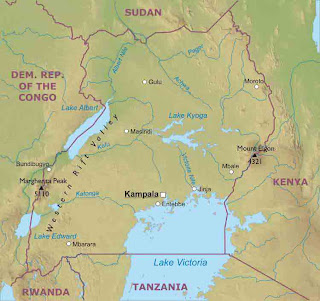
The Backdrop: A Brief Profile of Uganda


Full Name Republic of Uganda
Location Eastern Africa 
Population 33.8 million (UN, 2010) 
Area 241,038 sq km (93,072 sq mile--about the size of Oregon) 
Climate Tropical; little annual variation (17-28C/63-82F) with rainy and dry seasons
Terrain Mostly plateau with a rim of mountains 
Capital 
Kampala (2009 pop. 1.5 million)


City of Kampala

Major languages English (official), Swahili (official), Luganda, various Bantu, Nioltic, and local languages 
Major Religions Roman Catholic 33%, Protestant 33%, Muslim 16%, indigenous beliefs 18% 
Education 2008 primary school completion rate—56% 
Literacy (age 15 and over who can read and write) 69.9%; male--79.5%, female—60.4% 

Government type Republic
Independence October 9, 1962 (from the UK) 
President and Commander in Chief Yoweri Museveni 
Vice President Gilbert Bukenya 
Prime Minister Apollo Nsibambi 
Ambassador to the United States Perezi K. Kamunanwire 
GDP (nominal, 2009) $15.7 billion (US: $14.2 trillion) 


Natural Resources Copper, cobalt, hydropower, limestone, salt, phosphate, oil 
Agriculture Cash Crops—coffee (Africa’s second largest producer), tea, cotton, tobacco, cassava (tapioca), potatoes, corn, millet, cut flowers. Food crops—bananas, corn, cassava, potatoes, millet, pulses. Livestock and fisheries—beef, goat meat, milk, poultry, Nile perch, tilapia 
Current environmental issues draining of wetlands for agricultural use, deforestation, overgrazing, soil erosion, widespread poaching, water hyacinth infestation in Lake Victoria 
Major infectious diseases: Food or waterborne—bacterial diarrhea, hepatitis A, typhoid fever; vectorborne diseases—malaria, yellow fever, and African trypanosomiasis (sleeping sickness)